
Camden County Previous Residents by Era
Start a previous residents search with the period you need to prove. A recent ownership question begins with the current parcel and the Clerk's web index. An older address may require a deed book, microfilm, FamilySearch images, a library reel, or a Historical Society lookup. People who lived at an address do not always appear in the deed trail, so pair land records with a dated directory or census record. Camden County's 1844 creation also creates a boundary: land research before that date belongs to Gloucester County, even when the modern address is now in Camden County.
| Source | Years it covers | Where held | What it shows |
|---|---|---|---|
| Clerk online deed index | 1978 to present | Camden County Clerk NewVision | Recorded documents and a modern ownership chain |
| Camden deed books and images | 1844 to 1901, with Archives microfilm through 1900 | Clerk, State Archives, FamilySearch, Historical Society | Earlier conveyances, legal descriptions, and parties |
| Camden directories and street sections | Society most years 1839 to 1947; Library reels 1863 to 1947 | Historical Society and Camden County Library | Dated household or address-listing clues |
| Telephone books | Society most years 1921 to 1998; Library 1960 to present | Historical Society or Library | Listed subscriber and address clues |
| Federal and state census | Federal 1830 to 1950; state 1885, 1895, and 1905 locally held | Society, Library, Archives, and research databases | Household composition at an enumeration date |
| Permit, tax, or map record | Varies by municipality and collection | Municipal custodian, Society, or map repository | Building, property, or address context |
For a recent transfer, begin with the online deed index. For an old house with no web result, begin at the legal parcel and change channels rather than assuming the address has no history. The relevant municipality may be the next stop for permits, code files, or assessment corrections.
Deed Chain for Camden County Previous Residents
A chain of title follows ownership of the same parcel backward. Pull the present owner and block, lot, or other legal description from the Camden County tax-data hub or myiDV parcel viewer. Then use the current owner as a grantee in the Clerk's recorded-document search. The deed that placed the owner in title identifies the grantor, who becomes the next person to check as a prior grantee. A street number alone can fail because an older instrument may use only lot, block, subdivision, metes-and-bounds, or adjoining-owner language.
- Record the current parcel's municipality, address, block and lot, PIN if shown, and legal description.
- Search the owner as grantee in Camden County Clerk SearchAnywhere, then narrow by town, deed type, date, or lot and block.
- Capture the recording date, file or book and page, consideration, grantor, grantee, and legal description from the purchase deed.
- Search that seller as the earlier grantee, comparing the legal description at every link instead of trusting a repeated street number.
- When the online chain reaches its coverage limit, move to the Clerk's counter or deed books, State Archives microfilm, FamilySearch images, and Historical Society deed holdings.
- Grantor / grantee
- The grantor transfers an interest in land. The grantee receives that interest through the recorded instrument.
- Chain of title
- The sequence of conveyances connecting an earlier owner to a later owner of the same parcel.
- Legal description
- The recorded land identifier, such as lot and block or metes and bounds, that can bridge changing street names and numbers.
- Criss-cross directory
- A reverse street listing that can connect an address to a listed householder or subscriber for the date of a volume.
Note: Mortgages, assignments, releases, liens, and cancellations can clarify a parcel event, but a deed is the core ownership document.
Camden County Previous Residents After 1978
The Clerk's public web index covers official records from January 1, 1978 to the present and is updated nightly. Free basic access needs no account, allows unlimited printing, and provides watermarked unofficial images of primary documents such as deeds, mortgages, discharges, and cancellations. The listed $25-per-month premium tier provides additional document classes and watermark-free copies. Search all spelling variations, because NewVision uses party indexing and a single name form can miss a filing.
This 1978 access point is useful but should not be mistaken for the beginning of a property's history. A chain that stops at the web cutoff may continue in paper or microfilm. The Camden County Online Property Records page describes the online choices, while the Clerk's Registry Division remains the primary custodian for recorded deeds and mortgages.
Camden County Previous Residents Before 1844
Camden County was created from Gloucester County on March 13, 1844. That date is a critical handoff for a house history. Recorded Camden deeds begin with the new county, while land records before creation are Gloucester County records. Early census, tax, and township material can also use older boundaries or township names, so an address history may be filed under Gloucester County, Old Gloucester County, Delaware Township, Camden City, or a later municipality. Search the historic county and township names along with the modern address.
Camden County Historical Society reports digitized Camden deeds for 1844 to 1901 and Gloucester deeds for 1787 to 1901 through FamilySearch. It also reports nearly 4,000 original deeds, including some early items that were never recorded. Those originals can explain why a strictly modern Clerk chain begins late or appears to skip a transfer. Duplicate recorded-deed copies at Camden City Hall are an access fallback, not a replacement for the Clerk's index.
Map a Camden County Address Across Time
Maps give a past address physical context before a name is attached to it. The Historical Society holds owner-labelled Camden maps and atlases for 1856, 1877, 1886, 1902, 1907, Sanborn years from 1913 to 1925, Atlas Directory 1926 to 1927, and 1935. Its Sanborn microfilm includes Camden editions from 1885, 1891, 1906, and 1926. The Library of Congress provides a digitized 1906 Camden volume with 79 sheets. Use a map to test a street layout, lot relationship, or building use, then return to deeds and directory entries for names.
The Camden County Historical Society library image points to the repository that combines maps, tax material, directories, original deeds, newspapers, census, and staff research.
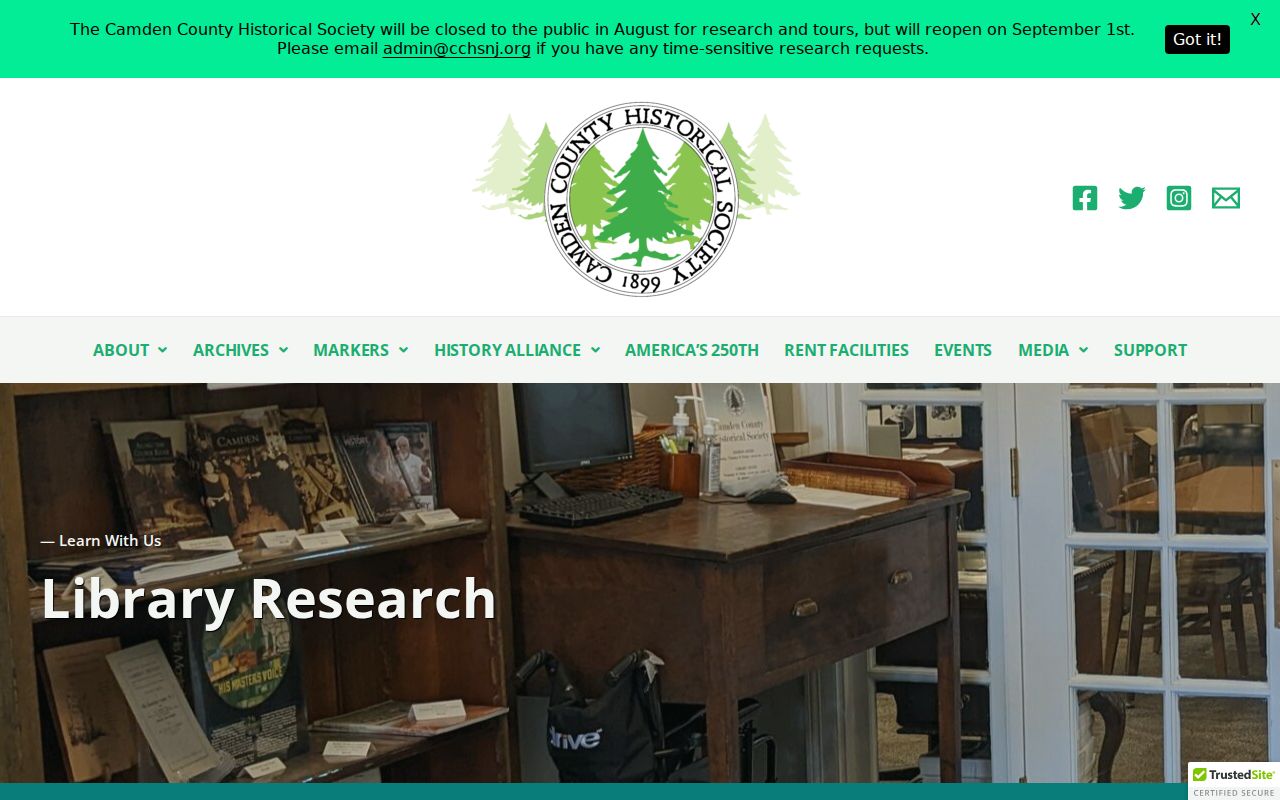
That collection makes the history around a former address more concrete: a map or tax ledger can establish property context, while an address listing, obituary, or deed supplies the dated human connection.
Camden City tax ledgers from 1850 to 1938 are incomplete, and other municipal tax books have their own date ranges. Use them as supplemental timing evidence, not a substitute for a recorded conveyance.
Pair Camden County Directories and Census
Ownership does not answer every previous residents question. A dated street or alphabetical directory entry may attach a person to an address, while the census can show a household at its enumeration date. Compare the two rather than treating either as absolute. Camden sources include federal census material from 1830 through 1950, and the Historical Society holds New Jersey state census material for Camden County in 1885, 1895, and 1905. The directory collections and their precise gaps are described on the Camden County city directory page.
- Find the address or householder in the closest available directory year and record the exact printed form of the name and address.
- Check the same person's spelling variants and occupation or relationship clues in the nearest public federal census or the available state census interval.
- Compare the municipality and street context with a deed, tax record, or map, especially where older township and modern municipal names differ.
- Use an obituary, newspaper notice, cemetery entry, or probate record to close a date range when a household disappears from an address listing.
A directory omission can mean a coverage gap, publication timing, a boundary issue, or an omitted person. It is not proof that a former occupant was absent.
Camden County Previous Residents in Collection Gaps
The Library's 25 directory reels are valuable but not continuous. Its published gaps include 1868, 1871, 1873, 1918 to 1919, 1932 to 1939, 1941 to 1942 in one later run, and 1944 to 1946 in another. The Library identifies later runs for selected nearby towns, so a Camden County address must be matched to the municipality actually covered by that volume. The Historical Society, newspapers, census databases, FamilySearch, Ancestry Library Edition, HeritageQuest, and the State Archives provide bridges when the expected directory is missing.
For a request that spans several sources, the Historical Society offers staff research and an inquiry form. Its published terms include a $5 specific lookup and $25 per hour for general research. Use a close date, municipality, property address, and variant names in a request so staff can select the correct shelf or microfilm run. Check access conditions before a visit because archive availability can change.
Note: The later Library directory runs do not make every Camden County municipality a complete annual directory, so record the specific volume's scope.
Camden County Past Residents at Trail Endpoints
When a former resident leaves the directory trail through death or estate settlement, use the record that fixes the event in time. The Historical Society's Death, Burials & Obituaries Database reports almost 225,000 names from the 1700s to the present, alongside cemetery, newspaper, and WPA material. The Society and Library also hold local newspaper resources. An obituary can connect a person to a date, relatives, and a last-known place, but it should be read alongside the address evidence rather than used to assign a person to a parcel without corroboration.
The Camden County Surrogate keeps estate records and microfiche for county estates and related Superior Court proceedings from 1851. Probate can identify an executor or administrator, heirs, addresses, estate assets, and property references. The Surrogate provides mail, a drop box, and in-person appointment access; sealed adoption filings remain restricted. Those channels are useful after a deed or obituary gives a date and legal name.
Limits of Camden County Previous Resident Research
A deed records a conveyance, not every person connected to an address. A directory or telephone listing is tied to its compilation date and scope. Census is a dated snapshot, and a map describes land or a building rather than a household. New Jersey vital records are restricted, not public records, and cannot be searched online. Municipal records must be requested from the correct custodian under the N.J. Open Public Records Act, N.J.S.A. 47:1A-1 et seq., where exemptions and redactions may apply.
Lawful house-history use. Camden County previous-resident research is appropriate for family history, estate work, preserving a property's story, and personal curiosity. Do not use a historic or current address trail to stalk, harass, intimidate, or harm a living person.